
On this page
In short
- Grow asks one question: does it compound without us pushing it?
- We renamed the stage from scale to Grow. The word scale describes spending more; Grow describes a product that keeps going when you stop pushing.
- Compounding comes from things that outlast the team's effort: documentation, a brand system with a named owner, and customers who bring the next ones.
- Grow is where a venture graduates, from the studio and from us. The aim of every engagement is a team that can run the method without us.
Every stage before this one needs a push. Someone has to test the problem, cut the scope, ship the build, chase the retention and package the launch. Grow is the stage where the push should matter less each time. It's also the stage that's easiest to claim and hardest to show, which is why we're careful with it, starting with our own portfolio.
01What does Grow mean in Stuck-to-Scale?
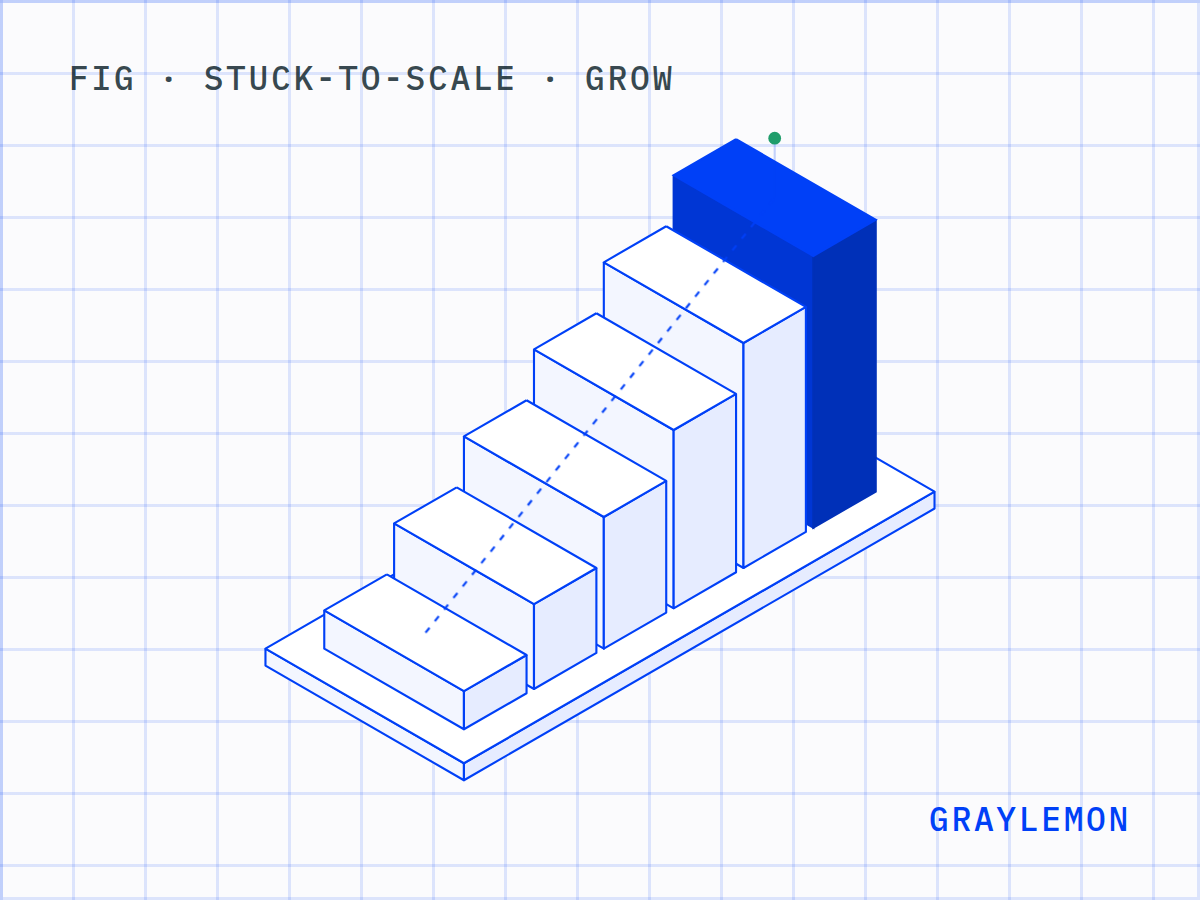
Grow is the sixth and last stage of Stuck-to-Scale. Its question: does it compound without us pushing it?
"Compound" means each unit of effort produces more than the last, because earlier work keeps paying. A customer who brings the next customer. An article that's still being found, and quoted, long after it went up. A product documented well enough that new people ship without asking. A brand consistent enough that each launch builds on the one before it.
"Without us pushing it" is the test. What happens when the founding team, the studio or the agency steps back? If growth stops when they stop, the venture is still at Market, however large it looks from outside.
For a venture built inside a studio, Grow is also graduation: the point where it stands on its own as an independent company.
02Why is the stage called Grow, not scale?
Because the old name described the wrong thing. Our previous website called the sixth stage scale. When we tore that website down and rebuilt the method's language, we changed it.
Decision · the last stage is Grow
- What we chose: Grow, with one question attached: does it compound without us pushing it?
- What we gave up: a word founders and investors use constantly, and one that looks good on a slide.
- Why: scale describes an input: more spend, more people, more reach. Inputs can be bought. Grow describes a result we can check: the product keeps growing when the push stops. Buying reach for a product that doesn't compound only widens the gap.
- What it changed: the gate at the end of the method is a test, not an ambition. The method keeps its name, Stuck-to-Scale, because that's the direction a founder wants to travel. The last stage is judged on compounding.
03What does being stuck just short of Grow look like?
| Signal | What it looks like | What it usually means |
|---|---|---|
| Growth stops when the founder stops | Every deal, post and launch runs through one person | The founder is the channel |
| Every channel needs the team | Nothing brings customers in on its own | Reach is still pushed, not pulled |
| The brand fragments | Each new page, deck and feature looks slightly different | Guidelines exist, but nobody owns them |
| Knowledge lives in heads | New people ask the same questions | Nothing was written down for whoever comes next |
| The partner can't step back | The studio or agency is still in every decision | The handover never happened |
04What has to be true for a product to compound?
Four things, and none of them is a bigger budget.
- Each customer makes the next one easier. They recommend it, they're seen using it, or the product itself gets better as more people use it.
- What you publish keeps working. Articles, documentation and pages that are still found and read, by people and by AI search, long after they go up.
- The brand holds together as more people ship. That takes a system, not a folder of files. Brand OS Layers sets out five layers, from strategy at the bottom, through verbal, visual and motion, to governance at the top, with a named owner.
- The team can run the method without the people who set it up. Documentation, runbooks, and decisions written down with their reasons.
Insight
Guidelines without a named owner and an approval path fail by default. Governance is a deliverable, not a nicety.
05What do we hand over so a product can compound?
The intended outcome of every engagement is that the client can run the method themselves. So the last piece of work at every stage is making ourselves less necessary.
- Documentation, and a proper handover. The architecture, runbooks, and model and prompt documentation with the reasoning behind each choice. Product documentation written to be read by machines as well as people. A handover session with the team who'll run it.
- A brand operating system. Guidelines, rules and approval workflows, a named brand owner, and brand documentation that AI tools can use too, so what's published tomorrow matches what was published today.
- The method itself. The frameworks we use are published in the Framework Library, so a team can keep running the stages after we've gone.
The last deliverable of every engagement is a team that doesn't need us.
06Where are our own ventures?
Plainly: neither is at Grow. otlo is in market with paying customers, and we'll only claim fit once retention data supports it. apprn is in a live test with real salons, and will be judged against kill criteria set before the test began.
So this is the stage we describe from the method, not from a finished case. When one of our ventures reaches it, we'll write that build log with the evidence. Until then, a studio that claims Grow for ventures that haven't reached it is telling you something about all its other labels too. We explain why in How to evaluate a venture studio before you back one.
And Grow isn't an ending. For a company that has reached it, the next product or venture starts back at Ideate, with the same questions and the same gates.
07Questions founders ask about Grow
How do we know a product has reached Grow?
Growth continues as the founding team steps back: customers arrive without being chased, what you've published keeps bringing them in, and new people ship without breaking the brand. If growth stops when the push stops, you're still at Market.
Isn't Grow just another word for scaling?
Scaling is usually described by inputs: more spend, more people, more reach. Grow is described by a result: compounding. You can buy inputs. You can't buy compounding.
What does Graylemon do at the Grow stage?
Less, on purpose. We hand over the documentation, a brand system with a named owner, and the method, and then we step back. The test of our work at this stage is how little you need us.
When does a studio venture leave the studio?
At Grow. That's the gate we use: a venture graduates when it compounds without the studio pushing it.
Where this fits