
On this page
In short
- Start from the assets, not the idea. A venture only this business could start has an advantage from the first day.
- Decide whether there's a venture at all before anyone builds: a thesis, a buyer with exclusions, and a stop line.
- Set it up beside the core business. It borrows the assets, not the approval process.
- Name two people before you start: one who decides at each gate, and one who owns go-to-market.
- Test with your own customers, carefully, and read the result against criteria written before the test.
- Fund it phase by phase, so each phase has to earn the next.
The founders of established businesses, and the next generation stepping into them, are being told two things at once: that AI will change their industry, and that startups with none of their advantages are coming for their customers. Both can be true. But a business with decades of customer trust, years of data and a working distribution network is better placed to build an AI venture than almost any startup, if it builds the right one, in the right structure, with the right people deciding. This guide walks through how.
01Why can an established business build a venture a startup can't?
Because a startup's hardest problems are the ones an established business has already solved. A startup has to find its first customers, earn their trust, collect enough data to be useful and build a route to market, all before it runs out of money. An established business starts with all four.
- Customers who already trust you. The first sale is the hardest one for a startup. You can put a new product in front of people who already buy from you.
- Data nobody else holds. Years of orders, service records or customer questions: the raw material an AI product needs, and a startup can't buy.
- Distribution. Sales teams, delivery routes, dealer networks, a shop floor: a way to reach buyers that already works.
- Supplier relationships and brand trust in your market, which open doors a newcomer would spend years knocking on.
The catch is that these assets only help if the venture is built on them. A business that starts a generic AI product, the same one a startup could build, gets none of the advantage and all of the distraction. We wrote about this in the Journal, in what your family business has that no AI startup can buy.
02How do you find the venture your assets make possible?
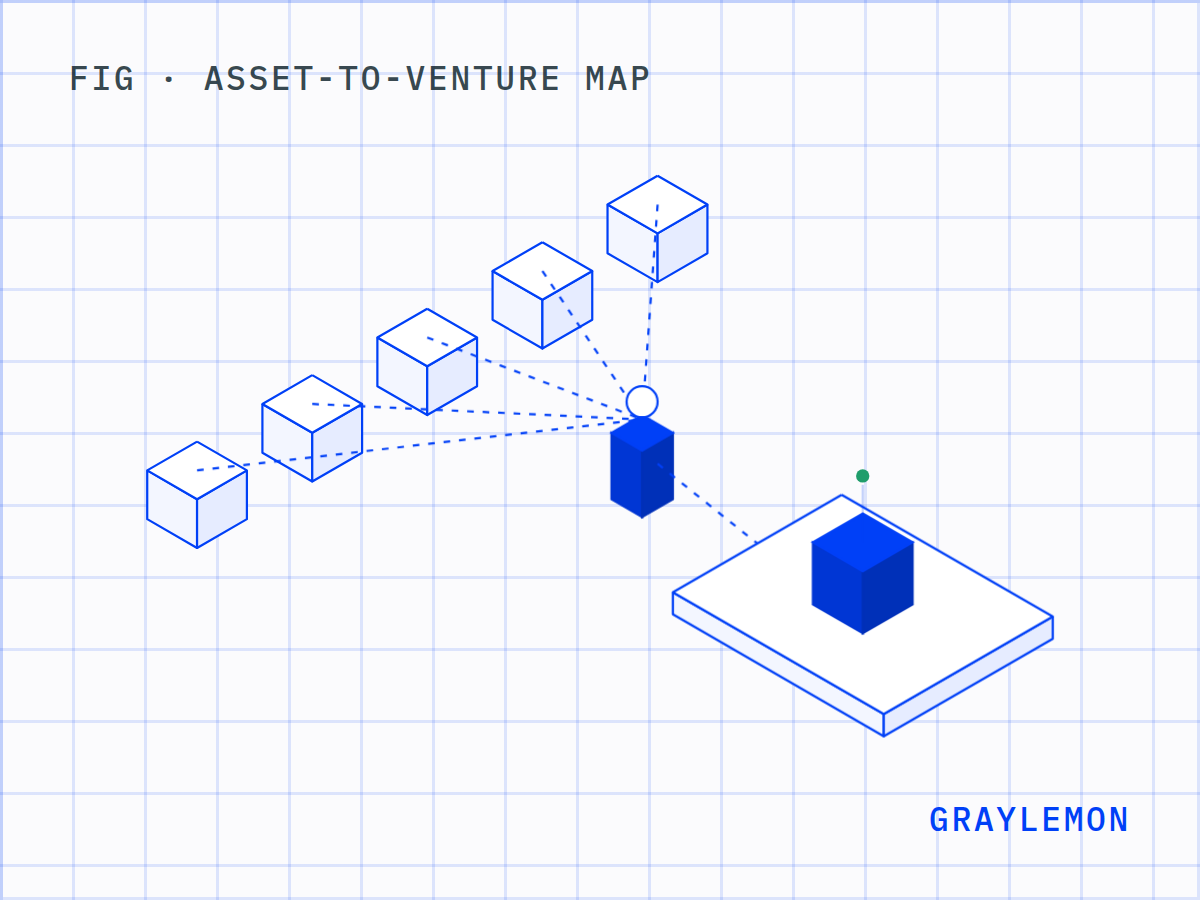
Map from the assets to the venture, not the other way round. That's the Asset-to-Venture Map, and it runs in four steps:
- Assets. List what the business holds, in five kinds: customers, data, distribution, supplier relationships and brand trust. Write down what each is worth, in a sentence someone outside the business could check.
- Advantage. Combine them into something a startup couldn't do on day one: reach a buyer through a trusted route, learn from data nobody else has, sell alongside something customers already buy.
- Venture direction. A product that only works because of that advantage, for a buyer the business already knows.
- First test. The smallest thing that proves the direction, run through the assets you listed.
The test of a good map is simple: remove one of your assets and see whether the advantage survives. If it does, it isn't really yours, and a startup can build the same venture.
Two checks belong at the asset step, before anything else. First, whether you can actually use each asset: data you're not permitted to use, or customers the core business won't let the venture contact, aren't assets for the venture. Second, whether using them risks the core business: a venture that damages the trust it borrowed has cost more than it could earn.
03What kinds of venture suit an established business?
Most ventures built beside a business take one of three shapes. Knowing which you're building changes who the buyer is and how you'll reach them.
- Serve your existing customers better. A new product for the people who already buy from you, built on what you know about them. The buyer is familiar and the route to them already works; the risk is that the venture looks like a feature of the core business rather than a business of its own.
- Sell what you know to others. Turn the data or the expertise the business has built up into a product for other businesses in your industry. The advantage is knowledge a startup can't gather; the risk is that competitors won't buy from a business they compete with.
- Turn an operation into a product. Something the business already does well for itself, such as scheduling, logistics or quality checks, packaged for others who do the same thing badly. The product is proven in-house; the risk is that what works inside your walls depends on things outside buyers don't have.
None of the three is better than the others. What matters is choosing one deliberately and knowing its risk, because each needs a different buyer, a different route to market and a different stop line.
04How do you decide whether there's a venture at all?
Before anyone designs anything, put the direction through the six questions of Idea Diagnosis: is the problem real, who has it, what they do about it today, whether there's evidence they'd pay, why now, and what your unfair advantage is. The map has already answered the last one; the other five need evidence of their own.
The output of this stage is a venture thesis, written down:
- The thesis: the problem, the buyer and the advantage, in a paragraph.
- The buyer, with exclusions: who it's for, and just as clearly, who it isn't for. Exclusions stop a venture drifting into serving everyone the core business serves.
- The market and the gap: the competitors named, the evidence of demand, and the category decision.
- The positioning: what it is, in one sentence a buyer would repeat.
- The kill criteria: the result that would make you stop, written before anything is built.
This stage ends in a go or no-go decision. A no-go here is a success: it cost a fraction of what a failed build would have, and the business keeps every asset it started with.
05Should the venture sit inside the business or beside it?
Beside it. The venture borrows the assets, not the approval process.
Inside the core business, a venture inherits everything that makes the core business work well at scale and badly at the start: budget cycles, committees, risk policies written for a mature operation, and a calendar full of the core business's priorities. Each one slows a venture that needs to make small decisions quickly and change its mind when the evidence says so.
Beside the business means:
- Its own decisions. One person decides at each gate, with the authority to say go or stop.
- Its own stop line. The kill criteria are the venture's, not the core business's annual targets.
- Agreed access to the assets. Written down: which customers it can contact, which data it can use, which parts of the distribution it can ride on, and how.
- Protection for the core relationships. Rules for how the venture approaches the business's customers, agreed with the people who own those relationships.
The legal and ownership structure is a decision for your advisers, and it depends on your sector and jurisdiction. What matters for the venture is that the structure lets it decide and move without asking the core business's permission for every step.
06Who needs to own it?
Two people, named before the work starts.
- A decision-maker who can say go or stop at each gate and mean it. In a family business this is often the promoter or the next-generation leader driving the venture. If every gate needs a family meeting, the venture will move at the speed of the family calendar.
- A go-to-market owner on the business's side, responsible for taking the product to its first buyers. This is the role most often left empty, and the one most ventures fail without.
A venture without these two is a project with no one to finish it. It's worth being blunt about this before any money is spent: if nobody can be named, the right decision is to wait until someone can.
07What should you decide before building anything?
The result that would make you stop. Kill Criteria are written before the test, while you can still read them without flinching, and ideally shared with everyone who'll judge the venture later.
Good kill criteria are:
- Behavioural, about what customers do, not what they say: they use it without being chased, they come back, they pay.
- Specific to this venture, set from where the business is today, not borrowed from someone else's benchmark.
- Few. Two or three results, each with the evidence that would show it.
In a family business the stop line does a second job: it takes the decision out of family politics. When the criteria were agreed in advance, stopping is the plan working, not somebody's project failing.
08How should the venture use the business's data?
Carefully, and with permission in writing. The business's data is often the venture's biggest advantage, and its biggest risk if it's used in a way customers didn't expect.
- Check what you're allowed to use. Data collected for one purpose may not be usable for another under your contracts, your customers' expectations or the law where you operate. Take advice before you design around it.
- Check that it's good enough. Years of records are only an asset if they're complete, consistent and reachable. Look at the data before designing the product, not after.
- Use the least you need. A first test rarely needs everything. Start with the narrowest slice that proves the direction.
- Keep it where the business can control it. In the business's own accounts, with a clear record of who can see what.
Where the venture depends on a model, the Remove-the-AI Test is worth running early. A surprising number of ventures built on a business's data need rules and a good interface far more than they need a model, and are cheaper and safer for it.
09How do you test it with your own customers without risking them?
Your customers are the venture's first channel, and its biggest risk. Test with them, carefully:
- Choose a small group deliberately. Customers who have the problem, who'll tell you the truth, and whose relationship with the business can take an honest experiment.
- Tell them it's new. Customers forgive an early product they were told was early. They don't forgive one that was sold to them as finished.
- Test the behaviour, not the opinion. Whether they use it, return to it and would pay, rather than whether they say they like it. Customers who already trust you will be polite, which is exactly why opinions are the wrong measure. The PMF Signal Ladder lays out the rungs.
- Keep the core business's people close. The account managers or sales team who own these relationships should know what's being tested, and hear first if something goes wrong.
Then read the evidence against the kill criteria. Either it clears them and the venture earns the next phase, or it doesn't and you stop, having risked very little.
10How do you build and launch it?
The same way any AI product should be built, with one addition. The build runs through the stages of a product build: scope the first release, decide where a model earns its place and where rules will do, build on real data, test it like any other code, and release it in steps. How to scope an AI product covers the first part in detail, and Graduated Launch the last.
The addition is go-to-market, written into the plan from the start rather than bolted on at the end:
- A written go-to-market plan with a named owner on the business's side.
- Launch creative that shows the product's real moment, not a generic AI story.
- Instrumentation for activation and retention, so you can see whether people use it, not just whether they signed up.
- A regular metric review, where the decision-maker reads the numbers and makes the next call.
11How should it be funded?
Phase by phase, so each phase has to earn the next. A venture funded all at once tends to keep going after the evidence says stop, because the money is already committed. A venture funded in phases, with a gate at the end of each, stops cheaply when it should and continues with conviction when it shouldn't.
Three phases work for most ventures beside a business: a venture thesis (is there a venture here?), a prototype tested with real customers (do they want it?), and the build and launch (take it to market). Each ends at a gate with a go or no-go decision, made by the named decision-maker against criteria set in advance.
Each gate asks a different question. The first asks whether there's a venture worth testing, and the evidence is the thesis and the map. The second asks whether customers want it, and the evidence is their behaviour against the kill criteria. The third asks whether it's ready for the market, and the evidence is a go-to-market owner, a plan and the instrumentation to read it. A venture that can't produce the evidence for a gate isn't ready for the next phase, however much has been spent on the last one.
12What goes wrong most often?
Rarely the technology. In our experience the failures cluster in four places:
- Nobody owns go-to-market. The product gets built, and then everyone assumes someone else will sell it.
- The core business interferes. Approvals, priorities and people get pulled back to the main business whenever it needs them, which is always.
- The venture ignores its own advantage. It builds the generic product a startup would build, and then competes with startups on their terms.
- Nobody decided what would make it stop. So it doesn't, long after it should have.
Each of these is avoidable, and each is avoided in the same way: by deciding it in writing before the work starts.
13Worked example: a pharmacy distributor's first venture
Illustrative example A made-up family business, taken through the approach the way we'd take a real one. Not client work.
A regional pharmacy distributor supplies independent chemists. The next-generation leader wants to know whether there's an AI venture in the business.
- The map. Assets: chemists who order every week, years of their order history, delivery routes that reach them daily, and a name those chemists trust. Advantage: it knows what each chemist runs out of, and when, before the chemist does. Direction: a reorder assistant for chemists, suggesting next week's order on WhatsApp.
- The thesis. Chemists lose sales when stock runs out and tie up cash when they over-order. The buyer is the owner of an independent chemist; hospital pharmacies and chains are excluded. The stop line, written first: if chemists don't accept suggestions without a call from the sales team, stop.
- Beside the business. The next-generation leader decides at each gate. A senior sales manager owns go-to-market and agrees which chemists the venture can approach, and how.
- The test. Suggestions for a small group of chemists on existing routes, who are told it's new. The measure is whether they accept suggestions unprompted, week after week, not whether they say they like them.
- The gate. If the evidence clears the stop line, the venture earns its build and launch, with a go-to-market plan the sales manager owns. If it doesn't, the business stops, having risked a small test and none of its relationships.
14The checklist before you start
- The assets listed, each described in a sentence someone outside could check.
- Permission to use each asset for the venture, confirmed.
- The advantage, and a check that it disappears without your assets.
- The venture thesis: problem, buyer with exclusions, positioning.
- The kill criteria, written before anything is built.
- A named decision-maker for every gate.
- A named go-to-market owner on the business's side.
- Written rules for how the venture uses the business's customers and data.
- Funding agreed phase by phase, with a gate at the end of each.
Insight
The strongest venture a business can build is the one its competitors' startups would find hardest to copy. Start there, and let the assets choose the idea.
15Questions business owners ask
Do we need our own tech team to build an AI venture?
Not at the start. The venture needs a decision-maker and a go-to-market owner from the business; the building can come from a partner who builds ventures. What it does need is someone inside who can judge the work and make the calls.
Should the next generation lead it?
Often, yes, if they can be given real authority to decide at each gate. A venture led by someone who has to ask permission for every step will move at the speed of the permission.
Will testing a new product damage our customer relationships?
It can, if it's sold as finished or pushed on customers who don't have the problem. Choose a small group deliberately, tell them it's early, and keep the people who own those relationships informed.
What if the venture competes with our core business?
Decide that before you build. Sometimes a venture that cannibalises part of the core business is the right move, because a competitor will do it otherwise. It's a decision for the owners, made in advance, not a surprise found at launch.
How do we know when to stop?
When the evidence fails the kill criteria you wrote before the test. That's the point of writing them first: stopping becomes the plan working, not a judgement made under pressure.
Should the venture use the family business's brand?
It depends on what the brand is trusted for. If the venture serves the same customers with something close to what they already buy, the brand opens doors. If it's a different product for different buyers, a new name gives it room to be judged on its own, and protects the core brand if the venture stops.
Write the venture's stop line on the kill criteria worksheet, a free Word file with every field explained.
Where this fits